

INDUSTRIES
Robotics & autonomous systems.
We help robot manufacturers, autonomy developers and integrators connect machinery safety, AI performance and product cybersecurity. Our work covers industrial applications, autonomous mobile robots, service robots and humanoid systems that interact with people.
Engineer safe physical interaction
The robot’s intended use determines the hazards: movement near people, contact forces, unstable loads, unexpected motion or failure to stop. We connect risk assessment to safety functions, architecture, diagnostic coverage and verification.
- Human interaction, stopping behaviour and operating modes
- Sensor, actuator and control-system failures
- Safety requirements, mechanisms and verification criteria
Understand the limits of autonomy
We assess perception sufficiency, localisation and sensor fusion against the operational design domain. Lighting, occlusion, unusual objects and distribution shifts shape the scenarios and statistical evidence needed to justify operating limits, monitoring and fallback behaviour.
Keep connected behaviour dependable
Command integrity, message timing, communication loss and software changes can affect safety functions. We assess these dependencies together with threats, fault responses and the boundaries between application software and protective mechanisms.
ROS 2 & CONNECTED SPECIFICATIONS
Explore the STIG Robot demo
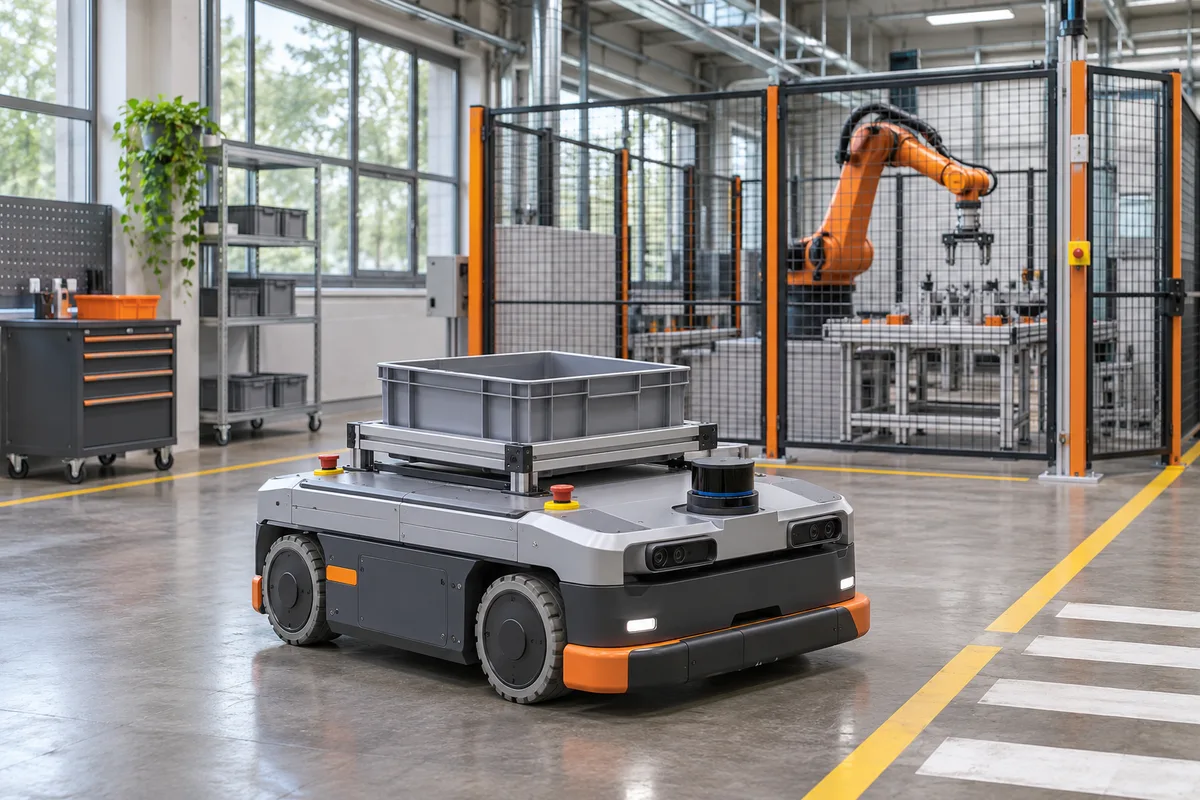
Our STIG Robot example models a ROS 2 indoor delivery robot with teleoperation and autonomous navigation. It brings requirements, architecture, safety and cybersecurity analyses, and verification specifications into one navigable model that teams can explore and adapt.
Open the ROS 2 robot demoFROM REQUIREMENTS TO EVIDENCE
Robotics regulations & standards
EU legislation
Legal requirements for products and systems within scope
Machinery Regulation
(EU) 2023/1230Physical and functional safety.
From 20 Jan 2027; Directive 2006/42/EC applies until then.
Cyber Resilience Act
(EU) 2024/2847Product cybersecurity throughout the lifecycle.
Main duties: 11 Dec 2027. Reporting: 11 Sep 2026.
AI Act
(EU) 2024/1689Risk-based AI requirements, including high-risk systems.
Scope and phased dates depend on AI classification.
Engineering standards & guidance
Machinery safety
Cybersecurity
- IEC 62443
- System risk assessment, security requirements, secure development and component security, including vulnerability handling and updates.
AI assurance
- ISO/IEC 23894
- AI risk management
- ISO/IEC TR 5469
- Functional safety & AI
- ISO/IEC 24029
- Neural-network robustness, including formal methods
Outside automotive, ISO 21448 (SOTIF) and ISO/PAS 8800 inform our methods where appropriate. See all engineering references.
Bring your engineering question.
Tell us about your system, the decision ahead and the evidence you need. We’ll help define a useful next step.